
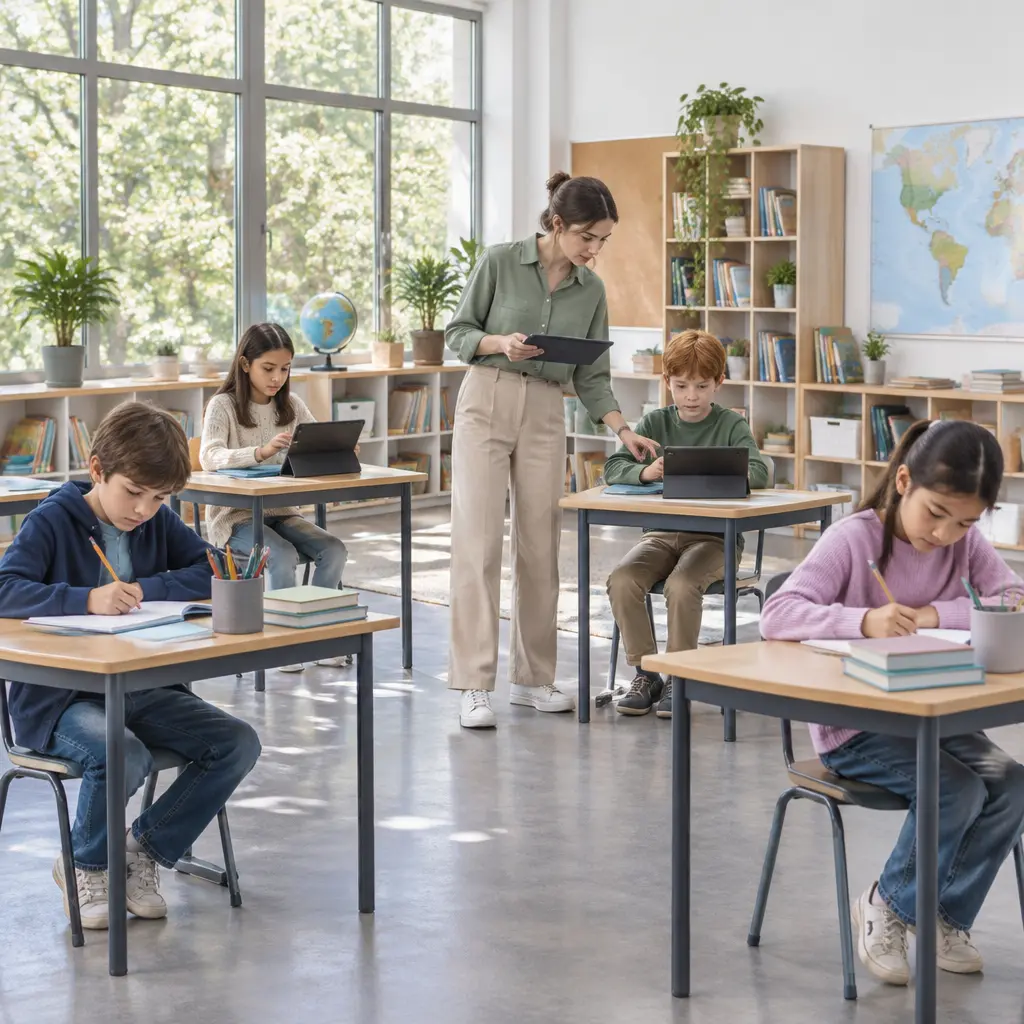
The Future of Personalized Learning: Trends in Adaptive Education
Personalized learning adapts instruction to learners’ needs, progress, interests, or circumstances rather than giving every student the same pathway at the same pace. Its future is likely to combine adaptive software, teacher-guided data use, accessible design, and carefully governed artificial intelligence. The opportunity is significant: the U.S. National Center for Education Statistics reported that 13.6% of public school students received special education services under the Individuals with Disabilities Education Act in 2022–23, underscoring the value of instruction that can respond to varied learning needs. But technology alone does not guarantee better outcomes. Research reviews find that results depend on instructional quality, implementation, and the way teachers use evidence of student learning.
Adaptive instruction defines the future of personalized learning
Personalized learning is an approach that tailors learning goals, content, pace, support, or ways of demonstrating understanding to individual students. The U.S. Department of Education’s Office of Educational Technology describes personalized learning as instruction paced to learners’ needs and shaped by their interests and preferences, while keeping high expectations for all students. Adaptive education is a closely related method: it uses evidence about a learner’s performance and needs to adjust instruction, often continuously.
These approaches matter because students enter classrooms with different prior knowledge, language backgrounds, disabilities, interests, and rates of progress. Adaptive tools can help educators identify gaps and provide targeted practice; teachers contribute context, judgment, encouragement, and human relationships. The central trend is therefore not simply replacing uniform lessons with software, but connecting flexible instruction with sound teaching and accountable use of data.
Adaptive learning systems
An adaptive learning system changes the learning experience in response to information such as answers, time on task, confidence, or demonstrated mastery. It may offer a hint, revisit a prerequisite concept, change question difficulty, or recommend a new activity. The U.S. Department of Education’s 2017 National Education Technology Plan identifies adaptive learning as one use of technology to personalize learning, while emphasizing that technology should support—not substitute for—effective teaching.
Adaptive systems are most useful when their adjustments are tied to clear learning objectives and reliable evidence. A correct answer alone may not prove deep understanding; a student might guess, memorize a pattern, or rely on assistance. Teachers should be able to review how a platform reaches its recommendations and use classroom evidence to confirm or challenge them.
Competency-based and mastery learning
Competency-based learning organizes progress around demonstrated knowledge and skills rather than time spent in class. Mastery learning is a related approach in which students receive feedback, additional instruction, and another opportunity to show understanding before moving on. These models can personalize pacing without lowering expectations: the destination remains clear, while the path and time needed may vary.
This distinction is important for interpreting progress data. A student moving quickly through digital lessons has not necessarily mastered the subject, just as a student taking longer is not necessarily falling behind. Schools need transparent standards, meaningful assessments, and opportunities to apply learning in new contexts.
Universal Design for Learning and accessibility
Universal Design for Learning (UDL) is a framework for designing instruction with learner variability in mind. The nonprofit organization CAST organizes UDL around multiple means of engagement, representation, and action and expression: students can encounter information in different ways, sustain motivation through varied supports, and demonstrate learning through suitable formats.
UDL and adaptive education are complementary but not interchangeable. UDL aims to make learning environments broadly accessible from the outset; adaptive tools can then provide additional, individualized adjustments. The National Center for Education Statistics reported that 7.5 million students ages 3–21 received services under IDEA in 2022–23, or 15% of public school enrollment. Accessible design—including compatibility with assistive technology, captions, readable interfaces, and alternative response formats—is therefore a core requirement, not an optional feature.
Learning analytics connect student evidence to instructional decisions
Learning analytics refers to collecting and interpreting information about learners and their contexts to understand and improve learning. The Society for Learning Analytics Research describes the field as the measurement, collection, analysis, and reporting of data about learners and their environments. In personalized education, analytics can help teachers spot misconceptions, monitor progress, and decide who may need an explanation, a challenge, or a different way into the material.
The value of analytics depends on whether data leads to an appropriate instructional response. A dashboard can show that a student repeatedly misses a type of question, but it cannot by itself establish why. The bridge from measurement to learning requires interpretation, conversation, and follow-up—not simply more metrics.
Formative assessment and immediate feedback
Formative assessment is the ongoing process of eliciting evidence of learning and using it to adjust teaching and student effort. In an adaptive environment, short quizzes, written explanations, practice attempts, and teacher observations can guide feedback while a unit is still underway. Effective feedback tells learners what is going well, what needs attention, and what action to take next.
The Education Endowment Foundation’s Teaching and Learning Toolkit reports that feedback has a high average impact in its evidence summaries, while cautioning that effects vary with the type and quality of feedback. This supports a practical principle: timely feedback is most useful when it is specific, understandable, and connected to a next step, rather than merely displaying a score or ranking.
Early-warning indicators and targeted support
Early-warning indicators use patterns such as missed assignments, declining performance, or low participation to flag learners who may benefit from timely support. In adaptive classrooms, these signals can prompt a teacher check-in, tutoring, a change in task difficulty, or referral to appropriate services. They should be treated as prompts for investigation, not as definitive judgments about a student’s motivation or potential.
Equity requires schools to test whether indicators work fairly across student groups. Data that reflects unequal access to devices, language barriers, disability-related needs, or inconsistent attendance can produce misleading conclusions. Educators should verify a signal with the student and consider context before making consequential decisions.
Dashboards and teacher decision-making
A learning dashboard presents student activity and progress in a visual format intended to support decisions. A useful dashboard prioritizes information teachers can act on, makes uncertainty visible, and avoids presenting proxy measures—such as clicks or time online—as if they were learning itself. Its role is to make evidence easier to interpret, not to automate professional judgment.
Implementation also affects whether dashboards help. Teachers need time, training, and access to understandable data. School leaders should examine whether a tool improves instructional decisions and student outcomes, rather than assuming that more data automatically produces better personalization.
Artificial intelligence is expanding personalization—and raising safeguards
Artificial intelligence is increasingly used in education to generate explanations, provide conversational practice, summarize performance, and recommend learning resources. Generative AI systems can produce responses to open-ended prompts, while predictive models estimate likely outcomes from existing data. These tools may make support more available, but their outputs can be inaccurate, biased, or poorly matched to a learner’s needs.
The U.S. Department of Education’s 2023 report, Artificial Intelligence and the Future of Teaching and Learning, calls for a human-centered approach that keeps educators involved in decisions and treats privacy, safety, and transparency as essential considerations. The report frames AI as a way to augment teaching, not remove human responsibility for instruction.
AI tutors and conversational practice
AI tutors are systems that respond to learner questions and provide explanations, hints, or practice through a conversational interface. They may offer additional low-stakes practice outside class, help students rephrase a question, or present an alternative explanation. Their educational value depends on the accuracy of content, the quality of instructional design, and a student’s ability to recognize when an answer needs verification.
A safe implementation sets boundaries: students should know when they are interacting with AI, teachers should review learning materials, and systems should not be treated as authoritative sources for high-stakes advice. For younger learners in particular, supervision and age-appropriate design are important.
Recommendation engines and next-step guidance
A recommendation engine suggests a lesson, activity, or resource based on a learner’s profile or recent performance. In education, it can help direct students toward prerequisite skills or enrichment. However, recommendations can narrow a student’s opportunities if past data or assumptions repeatedly steer them toward the same level or type of content.
Schools should review whether recommendations are explainable and whether learners can access a broad curriculum. Teachers need the ability to override a recommendation, and students should not be permanently defined by a short-term score or a system-generated label.
Privacy, bias, and responsible governance
Responsible governance means setting clear rules for what student data is collected, why it is collected, who can access it, how long it is retained, and how it is protected. The U.S. Department of Education’s Student Privacy Policy Office explains that federal laws such as FERPA regulate access to and disclosure of education records. Schools also need to assess vendors’ data practices and ensure that technology use aligns with applicable law and district policy.
Bias can enter through training data, design choices, or unequal patterns of access. Before adopting an AI-enabled product, schools should ask what evidence supports its educational claims, how it performs for different groups, whether students can challenge or correct records, and what happens if the system fails. Human oversight, data minimization, accessibility testing, and regular evaluation help translate innovation into responsible practice.
Implementation determines whether personalized learning improves outcomes
Personalized learning is not a single product or classroom model. It can involve teacher-designed small groups, flexible assignments, tutoring, adaptive practice software, competency-based progression, or combinations of these approaches. The relevant question is not whether a school has adopted a technology, but whether its instructional design helps students learn more effectively and equitably.
Evidence reviews reinforce this caution. The U.S. Department of Education’s 2010 meta-analysis of online learning found that blended learning conditions often had stronger outcomes than face-to-face instruction alone, but the authors noted that the advantage could reflect additional learning time, resources, and instructional elements—not simply the technology. That finding remains a useful warning against attributing results to software without examining how it was used.
Teacher-led blended learning
Blended learning combines digital instruction with in-person teaching and learning activities. A teacher might use an adaptive platform to identify a skill gap, then provide a small-group lesson while other students work on appropriately challenging tasks. The platform contributes practice and progress information; the teacher supplies explanation, discussion, relationship, and judgment.
A workable model protects time for direct instruction, collaboration, creative work, and student discussion. Digital practice should support the purpose of a lesson, not become a substitute for rich learning experiences or a way to keep students occupied.
Real-world example: New York City’s School of One
New York City’s School of One, launched as a pilot in 2009, became a prominent example of data-informed, individualized mathematics instruction. The model used daily assessments and a learning algorithm to recommend different activities, grouping students according to the skills they needed to develop. The U.S. Department of Education’s Office of Educational Technology has discussed the initiative as an example of personalized learning supported by technology.
The case illustrates both the promise and the complexity of adaptive education: students can follow different routes through content, but schools must coordinate schedules, instructional materials, assessment, and teacher roles. A historical example should not be mistaken for proof that any one model will work everywhere; local evaluation and adaptation remain essential.
Professional development and school capacity
Professional development prepares educators to interpret evidence, design flexible lessons, use accessible technology, and respond to student needs. It should be ongoing and connected to classroom practice. Teachers also need practical support: reliable devices, connectivity, technical help, planning time, and clear expectations about data use.
A thoughtful adoption process starts with a defined learning problem, evaluates tools against instructional and accessibility requirements, pilots the approach, gathers student and teacher feedback, and reviews outcomes before expanding. These steps reduce the risk of purchasing technology that is difficult to use or disconnected from learning goals.
Measuring impact and equity
Evaluation should examine learning outcomes alongside access, engagement, student experience, and teacher workload. Schools can compare results across learner groups, check whether students are receiving the intended support, and investigate unintended consequences such as reduced collaboration or overreliance on screen-based practice.
The future of personalized learning depends on measuring what matters. A platform’s completion rate or usage minutes is not the same as durable learning. Schools should combine assessment evidence with student work, teacher observations, and learner feedback, then adjust the approach when results show that a tool or practice is not working as intended.
Conclusion: personalized learning needs evidence, access, and human judgment
Adaptive instruction, learning analytics, artificial intelligence, and teacher-led blended learning are shaping the future of personalized education. Adaptive systems can adjust practice; formative assessment and dashboards can inform teaching; AI can expand access to explanations and recommendations; and UDL can make learning more accessible from the start. Yet the evidence and real-world examples point to the same condition: technology helps only when sound instructional design, capable educators, and appropriate safeguards guide its use.
Schools, families, and education leaders can take practical steps now: define the learning need before choosing a tool, involve teachers and students in evaluation, protect student data, test accessibility and fairness, and measure learning rather than activity alone. Further reading from the U.S. Department of Education, CAST, and the Education Endowment Foundation can help communities assess approaches and make informed choices.
Sources: National Center for Education Statistics, Students With Disabilities, Condition of Education, 2024, https://nces.ed.gov/programs/coe/indicator/cgg; U.S. Department of Education, Office of Educational Technology, National Education Technology Plan, 2017, https://tech.ed.gov/netp/; CAST, Universal Design for Learning Guidelines, https://udlguidelines.cast.org/; Society for Learning Analytics Research, What Is Learning Analytics?, https://www.solaresearch.org/about/what-is-learning-analytics/; Education Endowment Foundation, Teaching and Learning Toolkit: Feedback, https://educationendowmentfoundation.org.uk/education-evidence/teaching-learning-toolkit/feedback; U.S. Department of Education, Artificial Intelligence and the Future of Teaching and Learning: Insights and Recommendations, 2023, https://tech.ed.gov/ai-future-of-teaching-and-learning/; U.S. Department of Education, Student Privacy Policy Office, Family Educational Rights and Privacy Act (FERPA), https://studentprivacy.ed.gov/ferpa; U.S. Department of Education, Evaluation of Evidence-Based Practices in Online Learning: A Meta-Analysis and Review of Online Learning Studies, 2010, https://www.ed.gov/rschstat/eval/tech/evidence-based-practices/finalreport.pdf; U.S. Department of Education, Office of Educational Technology, School of One, https://tech.ed.gov/netp/