
Summer Academic Camp Selection Balancing Intellectual Challenge With Restorative Play
Summer academic camps work best when intellectual challenge and restorative play are planned as complementary parts of the day, not competing goals. A well-chosen program offers meaningful learning, supportive relationships, movement, choice, and enough downtime for children to recover. This balance matters because research links summer learning opportunities with academic and social benefits, while pediatric and education guidance emphasizes sleep, physical activity, and unstructured play as essential to children’s well-being. Families can compare camps by examining curriculum and teaching quality, the daily rhythm, age-appropriate expectations, access and cost, and the child’s own interests—then use those criteria to select a program that stimulates without exhausting.
Summer academic camp selection balances intellectual challenge with restorative play
A summer academic camp is a time-limited learning program that combines instruction or structured enrichment with the experiences and routines of a summer setting. The National Summer Learning Association describes high-quality summer learning as an opportunity to support academic, social, and emotional development—not simply as an extension of the school year. For families, the practical definition of a balanced camp is one that sets worthwhile learning goals while preserving time for play, rest, relationships, and child-directed exploration.
The need is both educational and developmental. The RAND Corporation’s evaluation of voluntary summer learning programs found positive effects in mathematics and, for students attending for multiple summers, benefits in language arts; the evaluation also showed that attendance and program quality matter. Separately, the American Academy of Pediatrics (AAP) describes play as important to children’s healthy development, supporting social-emotional, cognitive, language, and self-regulation skills. These findings do not mean every child needs an academic camp. They suggest that when families choose one, they should look for a design that makes learning engaging and leaves room for recovery.
Intellectual challenge defines a strong academic camp
Intellectual challenge is the degree to which a learning experience invites children to ask questions, make decisions, solve problems, create, and reflect at an appropriate level of difficulty. The National Summer Learning Association’s quality guidance emphasizes engaging, hands-on learning and supportive relationships rather than relying on worksheets or seat time alone. In practice, a challenging camp may involve a science investigation, a writing workshop, a mathematics puzzle, a coding project, or a history inquiry—activities that give learners room to try, revise, and explain their thinking.
Challenge is not the same as a heavy workload. A useful program has clear learning aims, responsive instruction, and activities adjusted for children’s prior knowledge. Families should ask what participants actually do, how staff respond when a child is stuck, and whether projects end in something learners can demonstrate or discuss. Those questions help distinguish active enrichment from a program that simply recreates a long school day.
Academic enrichment and inquiry-based learning
Academic enrichment deepens or broadens learning through subjects such as reading, mathematics, science, arts, and technology. Inquiry-based learning is a related approach in which children investigate questions, gather evidence, test ideas, and communicate what they discover. For example, a camp might ask students to design a paper bridge, measure how much weight it holds, and revise the structure after testing.
A National Research Council report on science learning emphasizes that children develop understanding through active engagement with scientific practices as well as scientific ideas. When assessing an enrichment camp, look for opportunities to explore, make mistakes safely, and explain results—not just listen to presentations. The best evidence of challenge is often the quality of the questions and projects, rather than the number of lessons completed.
Skill-building, feedback, and an appropriate level of difficulty
Skill-building camps focus on developing particular abilities, such as reading fluency, public speaking, musical performance, or programming. Strong instruction includes timely, specific feedback and chances to practice again. The U.S. Department of Education’s What Works Clearinghouse evaluates education interventions against evidence standards, a reminder that families can ask providers what outcomes they track and how they know an approach is helping.
A suitable camp stretches a learner without turning every activity into a test. Ask whether staff adjust tasks for different skill levels, whether children can pursue extensions or receive extra help, and how progress is communicated to families. This focus on responsive challenge leads naturally to the second half of selection: whether the program’s schedule allows children to remain engaged and well-rested.
Restorative play supports learning and well-being
Restorative play is enjoyable, developmentally suitable activity that gives children room to move, imagine, socialize, and make choices without constant adult direction or performance demands. It includes outdoor games, pretend play, building, creative arts, and quiet activities chosen by the child. The AAP’s clinical report on the power of play explains that play supports relationships and can help children practice executive-function skills, including planning, self-regulation, and flexible thinking.
Play is not merely a reward after “real” learning. It can be part of learning itself: a child negotiating game rules practices communication, while constructing a fort involves planning and problem-solving. However, restorative play also provides a change of pace from instruction. A balanced camp gives children both guided activities and meaningful stretches of free or lightly structured time.
Outdoor movement and active recreation
Active recreation includes games, sports, nature exploration, and other movement that raises activity levels while offering enjoyment and social connection. The World Health Organization recommends that children and adolescents ages 5–17 average at least 60 minutes per day of moderate-to-vigorous physical activity across the week. That recommendation is a health benchmark, not a requirement that every camp deliver the entire amount; families should consider how camp activity fits with the child’s full day and individual needs.
Review the daily schedule for outdoor time, safe facilities, shade and water access, and alternatives for extreme weather. Ask how staff supervise activities and accommodate children with disabilities, medical needs, or different comfort levels. A program that offers movement as a normal part of the day can help counter long periods of sitting and make academic sessions easier to sustain.
Unstructured choice, creativity, and social play
Unstructured play is child-directed activity with minimal adult control over its content and outcome. It may be imaginative, social, quiet, or hands-on. The AAP notes that play can support social competence and resilience, while research summarized in its clinical guidance recognizes the value of allowing children time to initiate and shape activities.
Families can ask how much of the day is scheduled, whether campers choose among activities, and whether staff facilitate peer interaction without directing every moment. A camp does not need to leave children unsupervised to offer autonomy: trained adults can maintain safety while letting children decide what to build, draw, pretend, or explore. This balance is especially important for children who need a break from tightly organized school-year routines.
Rest, sleep, and emotional recovery
Rest includes sleep, quiet time, and lower-stimulation periods that help children recover physically and emotionally. The Centers for Disease Control and Prevention, reflecting recommendations from the American Academy of Sleep Medicine, advises 9–12 hours of sleep per 24 hours for children ages 6–12 and 8–10 hours for teenagers ages 13–18. A camp cannot determine a child’s bedtime, but an overpacked day, long commute, or late-ending schedule may make healthy routines harder to maintain.
Check whether the program has transitions, quiet options, and a reasonable pace, especially for younger children or campers who are sensitive to noise and crowds. Watch for signs that the schedule is too demanding: persistent fatigue, irritability, reluctance to attend, or loss of interest in activities the child usually enjoys. A restorative program should leave room for children to return home with energy for family life and ordinary summer pleasures.
Camp selection turns program features into a child-centered decision
Choosing a camp means matching its learning approach and daily rhythm to a particular child, not searching for a universally perfect program. The National Summer Learning Association’s guidance encourages attention to engaging content, supportive relationships, and program quality. Families can use a short comparison process to make those qualities concrete before enrolling.
Compare the schedule, not just the brochure
A brochure may describe a camp as creative, rigorous, or hands-on without showing how those promises translate into a typical day. Request a sample schedule and identify the proportions of instruction, outdoor activity, meals, transitions, free choice, and quiet time. Ask how long campers sit at once, how frequently they move, and whether activities change by age group.
A simple comparison chart can make trade-offs visible. Families can score each camp from 1 to 5 on learning fit, play and movement, staff support, schedule, accessibility, and cost, while recording questions that need follow-up. The scores are a decision aid, not a scientific assessment; a child’s comfort and enthusiasm should remain part of the final choice.
Evaluate staff, safety, and inclusion
Staff quality shapes both academic challenge and emotional safety. Ask about staff training, supervision ratios, behavior guidance, emergency procedures, and how instructors support children who learn differently. For programs serving children with disabilities or medical needs, discuss accommodations in advance and confirm who is responsible for implementing them.
Safety also includes practical conditions: secure arrival and dismissal, access to drinking water and shade, procedures for medication, and clear communication with caregivers. The U.S. Centers for Disease Control and Prevention’s guidance on physical activity and heat safety can help families frame questions about hydration, hot-weather schedules, and breaks. A quality program should be willing to explain its policies plainly.
Weigh cost, access, and the child’s preferences
Cost includes more than tuition: transportation, meals, equipment, extended care, and time away from work may affect whether a program is feasible. Ask about scholarships, sliding-scale fees, payment plans, and public or community-based options. Also consider commute length and whether the camp’s hours fit the family’s routine; an otherwise appealing program may not be restorative if reaching it creates daily stress.
Include the child in age-appropriate ways. Let them compare themes, visit the site when possible, and identify what they hope to learn or do. Their preference is not the only criterion, but buy-in can increase comfort and participation. For a first camp experience, a shorter session or a familiar activity may be a better fit than an intensive, full-day commitment.
A balanced camp can be assessed through practical examples
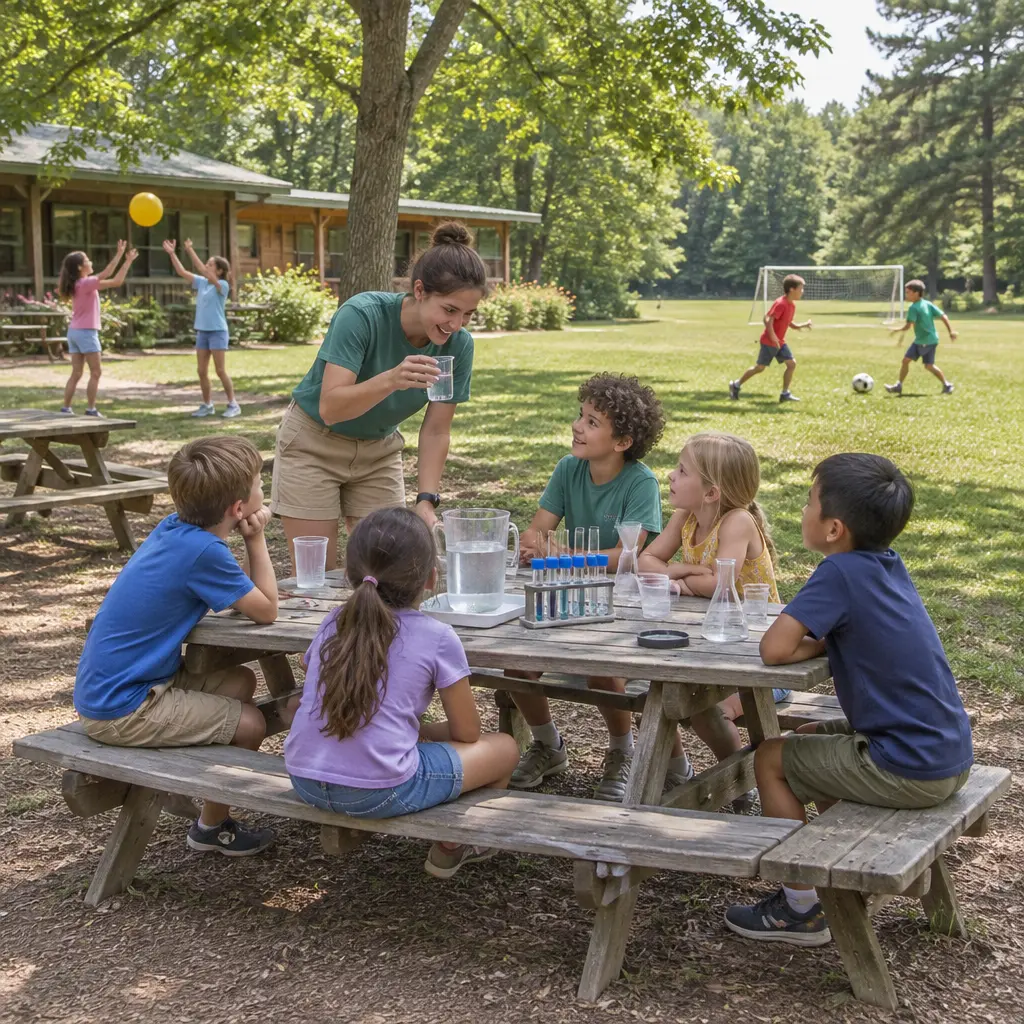
Consider a two-week environmental science camp. In the morning, campers investigate local water or plant life, record observations, and work in small teams. After lunch, they have outdoor games and a choice period for drawing, building, reading, or quiet rest. At the end of the session, they share a project with families. This design combines purposeful academic work, movement, autonomy, and a manageable endpoint.
Compare that with a program that advertises advanced science but schedules long blocks of lectures, offers little movement, and expects extensive evening assignments. The second option may suit a highly motivated older student seeking intensive preparation, but it may be a poor match for a child who needs social connection, outdoor time, or recovery from a demanding school year. Program quality is therefore contextual: the right balance depends on age, temperament, goals, and the rest of the child’s summer.
Families can monitor fit during the first week by checking in with the child and, when appropriate, the camp staff. Ask what was enjoyable, what felt difficult, and whether the child had time to play and rest. If fatigue or distress persists, discuss adjustments or consider a different schedule. These observations provide real-world feedback that a brochure or ranking cannot supply.
Conclusion: select for growth, recovery, and fit
Summer academic camp selection is strongest when intellectual challenge is paired with restorative play. Academic enrichment should invite inquiry, practice, and feedback; play and movement should support social, physical, and emotional well-being; and rest should protect the child’s capacity to participate. A thoughtful decision also accounts for staff quality, safety, inclusion, schedule, cost, and the child’s interests.
Before enrolling, compare a typical day, ask how the program adapts to different learners, and discuss the choice with the child. During the session, keep watching for both signs of engagement and signs of overload. For further guidance, consult the National Summer Learning Association, the American Academy of Pediatrics, and the Centers for Disease Control and Prevention. The goal is not to fill every summer hour, but to choose an experience that helps a child learn, play, and return to the school year rested and curious.
Sources: National Summer Learning Association, Summer Learning Program Quality Assessment (2021), https://www.summerlearning.org/; RAND Corporation, Learning from Summer: Effects of Voluntary Summer Learning Programs on Low-Income Urban Youth (2018), https://www.rand.org/pubs/research_reports/RR1557.html; American Academy of Pediatrics, “The Power of Play: A Pediatric Role in Enhancing Development in Young Children,” Pediatrics (2018), https://publications.aap.org/pediatrics/article/142/3/e20182058/38649/The-Power-of-Play-A-Pediatric-Role-in-Enhancing; World Health Organization, WHO Guidelines on Physical Activity and Sedentary Behaviour (2020), https://www.who.int/publications/i/item/9789240015128; Centers for Disease Control and Prevention, About Sleep, https://www.cdc.gov/sleep/about/index.html; National Research Council, A Framework for K–12 Science Education: Practices, Crosscutting Concepts, and Core Ideas (2012), https://nap.nationalacademies.org/catalog/13165/a-framework-for-k-12-science-education-practices-crosscutting-concepts; U.S. Department of Education, What Works Clearinghouse, https://ies.ed.gov/ncee/wwc/; Centers for Disease Control and Prevention, Heat and Health, https://www.cdc.gov/heat-health/