
STEM Program Authenticity Prioritizing Inquiry Process Over Polished Project Outputs
STEM program authenticity means designing science, technology, engineering, and mathematics learning around genuine questions, evidence, revision, and explanation—not judging success mainly by how polished a final project looks. Research on inquiry-based science and engineering supports giving learners meaningful opportunities to investigate and design, while also showing that guidance matters. Authentic programs therefore assess the inquiry process alongside products, use clear criteria and feedback, and make room for iteration, collaboration, and reflection. This approach is relevant to both learning and equity: the National Assessment of Educational Progress reported that only 26% of U.S. eighth graders performed at or above Proficient in science in 2022, underscoring the need for rich, evidence-based science learning rather than an emphasis on display alone.
STEM Program Authenticity Prioritizes Inquiry Process Over Polished Project Outputs
Defines STEM Program Authenticity Through Inquiry and Evidence
In this article, STEM program authenticity describes the degree to which a learning program reflects how scientific and engineering knowledge is developed: learners ask questions, investigate, use evidence, make or test solutions, revise their thinking, and communicate what they learned. It is not a single standardized label with one universally accepted definition. Instead, it draws on established frameworks, including the National Research Council’s A Framework for K–12 Science Education, which describes scientific and engineering practices as central dimensions of science learning.
An authentic STEM program can produce an impressive model, presentation, or competition entry, but appearance alone is weak evidence of learning. A visually refined outcome may reflect adult assistance, purchased components, or repeated rehearsal without demonstrating that students understand the problem, interpret results, or can explain design decisions. Conversely, a modest prototype or unsuccessful experiment can provide strong evidence of learning when students document what they tried, analyze results, and make reasoned changes.
The National Research Council organizes K–12 science learning around three connected dimensions: disciplinary core ideas, crosscutting concepts, and scientific and engineering practices. Its framework identifies eight practices, including asking questions, developing and using models, planning and carrying out investigations, analyzing data, constructing explanations, and engaging in argument from evidence. This provides a practical test of authenticity: are learners doing the intellectual work, or are they mainly assembling and decorating a predetermined result?
Inquiry-Based STEM Learning
Inquiry-based STEM learning begins with a question, problem, or phenomenon and asks learners to investigate it using evidence. Inquiry can be structured, guided, or more open-ended; these are related forms, not a requirement that every lesson be completely student-directed. In structured inquiry, the teacher may set the question and procedure. In guided inquiry, students make more decisions about methods or explanations. In open inquiry, students have greater responsibility for developing questions and investigations.
The National Research Council’s framework supports engaging students in practices such as planning investigations and analyzing data, while emphasizing that students need opportunities to learn and apply these practices over time. Inquiry is therefore not simply “letting students figure it out.” Teachers provide appropriate materials, background knowledge, safety expectations, questions, and feedback so that learners can pursue meaningful investigations without mistaking confusion for independence.
Engineering Design and Iteration
Engineering design is a process of identifying a need or problem, considering constraints, developing and testing possible solutions, and improving a design in response to evidence. The National Research Council includes defining problems and designing solutions among the core science and engineering practices. Iteration—the cycle of testing, learning, and modifying—is central: a first attempt is a source of information, not necessarily a final verdict on student ability.
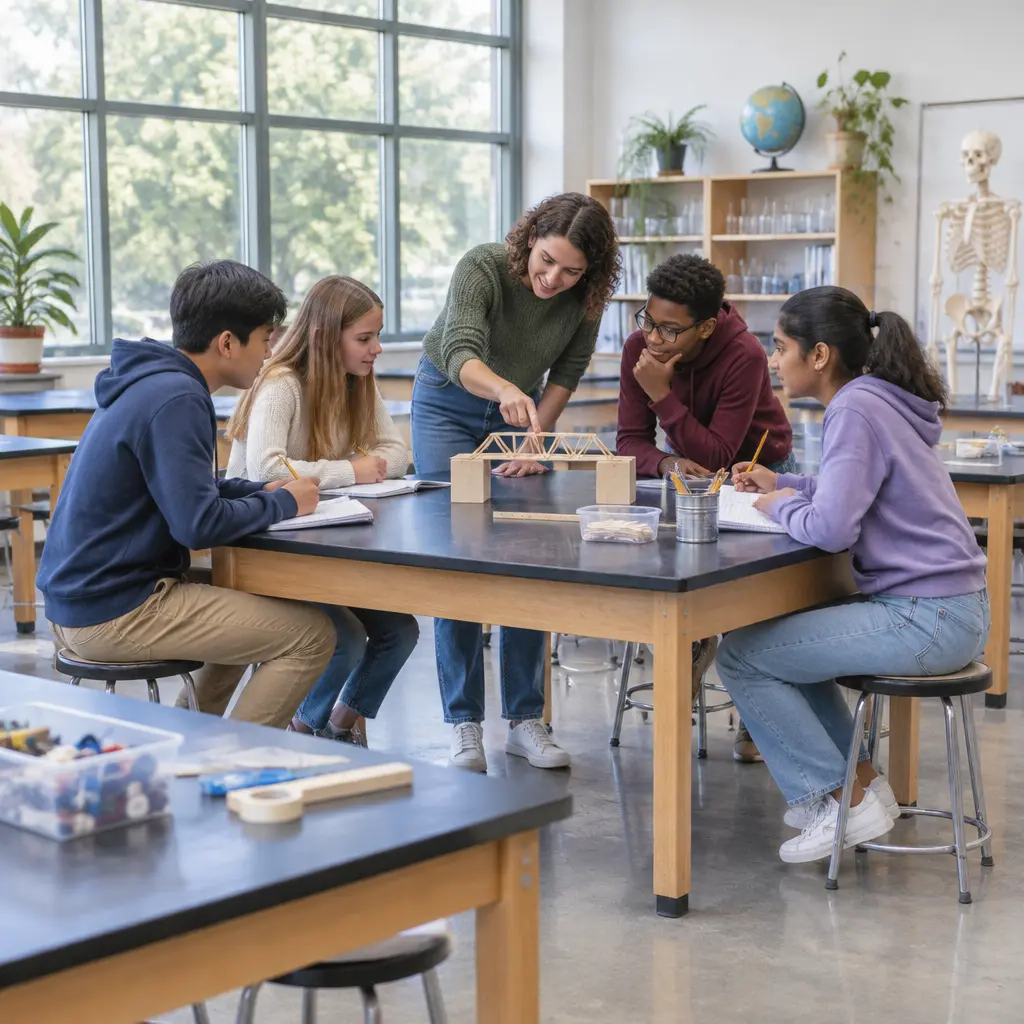
A bridge-building activity, for example, becomes more authentic when learners compare designs against specified limits for materials, cost, or load; record test results; and explain changes between versions. A display-ready bridge without evidence of testing may be less informative than an unfinished structure accompanied by thoughtful analysis of why it failed. The educational value lies in the relationship between the design choices and the evidence used to evaluate them.
Project-Based Learning and Performance Tasks
Project-based learning organizes learning around a sustained question or challenge, with students applying knowledge to create, test, or communicate a response. A performance task asks learners to demonstrate knowledge through an activity or product rather than relying only on selected-response questions. Both approaches can support authentic STEM learning, but neither guarantees it: a long project can still be a craft exercise if learners do not investigate, make decisions, or use evidence.
The National Academies’ science framework connects practices with disciplinary understanding rather than treating hands-on activity as an end in itself. A useful project therefore makes the learning goals visible, asks students to explain their reasoning, and includes checkpoints where feedback can shape later work. The resulting product is one piece of evidence within a broader record of student learning.
Measures STEM Program Authenticity Through Process-Focused Assessment
If authentic STEM learning depends on inquiry and iteration, assessment must capture more than the final object. The National Research Council’s Developing Assessments for the Next Generation Science Standards explains the need for assessments that elicit evidence of the integrated science dimensions. In practice, a program can collect evidence from student questions, plans, data tables, design versions, explanations, discussions, and reflections, as well as from final products.
Process Rubrics and Observable Evidence
A process rubric defines what competent inquiry or design looks like in observable terms. Criteria might include whether a student uses relevant evidence, records results accurately, considers constraints, explains a change, or responds constructively to critique. These criteria help distinguish the quality of thinking from the neatness, size, or visual appeal of a project.
Rubrics are most useful when students see them before or during the work and receive feedback while they can still act on it. The Education Endowment Foundation’s evidence review on feedback describes feedback as a high-impact approach when it helps learners understand the gap between current and intended performance and how to close it. A rubric should therefore guide next steps, not merely assign a score after the project is finished.
Portfolios, Design Logs, and Reflection
A learning portfolio is a curated record of work over time; a design log documents decisions, tests, observations, and revisions during a project. These tools make the process visible to teachers and learners. A useful log entry might identify a prediction, describe a test, record a result, and explain what the result suggests for the next version. Reflection then asks students to connect those decisions to concepts, evidence, and unresolved questions.
Portfolios can also support fairer assessment by showing growth rather than only a single performance on a deadline. They do not need elaborate software or lengthy writing. Sketches, photographs, short audio explanations, tables, and annotated prototypes can all document reasoning, provided that assessment expectations are clear and accessible to students.
Separating Product Quality From Learning Evidence
A fair assessment distinguishes between the quality of a finished product and the learning demonstrated in creating it. Product criteria may include whether a solution works under specified conditions. Process criteria may include the quality of testing, evidence use, collaboration, and explanation. Keeping these dimensions distinct helps avoid rewarding expensive materials, prior craft experience, or adult assistance as though they were evidence of scientific understanding.
This distinction does not mean that products are unimportant. A design’s performance is real evidence when it is tested against appropriate criteria. The key is to ask what the result demonstrates, how students know, and whether they can explain limitations. A failed test can support a high-quality explanation; a successful test without understanding may offer less evidence of transferable learning.
Builds Equitable and Authentic STEM Program Conditions
Authenticity depends not only on the task but also on whether students have a genuine opportunity to participate in the intellectual work. A project that assumes access to specialized equipment, adult technical help, or prior exposure may unintentionally measure resources rather than learning. Programs can reduce these barriers by providing materials, teaching relevant skills, offering multiple ways to communicate, and assessing reasoning separately from presentation polish.
Access, Belonging, and Multiple Ways to Contribute
An inclusive STEM program makes participation possible for students with different languages, abilities, experiences, and confidence levels. The National Academies’ 2022 report Science and Engineering in Preschool Through Elementary Grades emphasizes developmentally appropriate opportunities for children to engage in science and engineering practices. Practical supports include accessible tools, visual instructions, flexible group roles, assistive technologies, and options to explain learning orally, visually, or in writing.
Teachers should also make contribution patterns visible. In group work, one student may dominate construction while others are assigned decorative or administrative tasks. Rotating roles and asking every learner to explain a decision or interpret a result can help ensure that the project’s core reasoning is shared rather than reserved for a few students.
Teacher Guidance and Productive Scaffolding
Scaffolding is temporary support that enables learners to engage with a task they could not yet manage independently. It may include modeling how to measure, prompting students to compare results, providing sentence starters for evidence-based claims, or helping a group narrow an overly broad question. Scaffolding preserves student agency when it supports decision-making rather than supplying the answer or building the project for them.
The National Research Council’s framework describes learning as the integration of disciplinary ideas and practices. This means teachers must help students build the knowledge needed to investigate well: open-ended activity without relevant concepts or methods may produce effort but little understanding. Strong facilitation balances student choice with explicit teaching, purposeful questions, and timely feedback.
Time, Materials, and Community Connections
Authentic investigation requires time to plan, test, revise, and communicate. Programs that devote nearly all available time to assembly and decoration can crowd out the inquiry they intend to teach. A practical schedule reserves time for students to define a question, learn necessary concepts and methods, conduct tests, interpret evidence, improve a response, and reflect on results.
Community problems can provide meaningful contexts when they are connected to curriculum and student agency. For instance, students might investigate shade around a schoolyard, compare materials for reducing heat, or examine how water moves through a local site. The U.S. Environmental Protection Agency’s citizen-science resources illustrate how observations and data collection can connect science with real places and questions. Community relevance strengthens a project when learners still make and justify decisions; it should not replace explicit learning goals or sound investigation.
Uses Evidence and Case Examples to Validate STEM Program Authenticity
Evidence supports inquiry-rich learning, but it does not justify the claim that every open-ended project automatically improves outcomes. A major meta-analysis by Scott Freeman and colleagues, published in Proceedings of the National Academy of Sciences in 2014, examined 225 studies of undergraduate STEM courses. Across the studies, active learning was associated with an average increase of 0.47 standard deviations in examination and concept-inventory performance compared with traditional lecturing; students in lecture courses were also 1.5 times more likely to fail. These findings concern undergraduate active learning broadly, not school-age project work specifically, so they should inform practice without being treated as a direct estimate of the effect of any particular K–12 program.
The National Assessment of Educational Progress provides a separate indicator of the need to strengthen science learning. In 2022, 26% of U.S. eighth graders scored at or above Proficient in science, according to the National Center for Education Statistics. NAEP results describe achievement at a population level; they do not show that project polish caused or explains those outcomes. They do, however, reinforce the importance of teaching for substantive understanding and of checking whether students can use scientific ideas and practices.
Example: Testing a Classroom Cooling Design
A class investigating how to keep a small model space cool could compare shade, reflective surfaces, or insulation. Students first predict which approach will reduce temperature most, then identify variables, take consistent measurements, and record results. After comparing data, they revise their models and explain what the evidence supports and what remains uncertain. A chart of temperature over time would make patterns visible; a photograph of a polished final model would not, by itself, establish that students understood the investigation.
This example reflects the National Research Council’s integrated practices: students ask questions, plan an investigation, analyze data, use a model, and construct an explanation. The teacher can assess both whether a design met a stated performance target and whether each student can justify a design choice with evidence. A failed cooling strategy can still demonstrate strong learning if students identify flaws in the test and propose a defensible next step.
Example: Comparing Water-Filtering Materials
In a water-filtration challenge, students can compare materials such as gravel, sand, and cloth using a consistent procedure and a defined measure of clarity. The activity becomes more scientifically meaningful when students distinguish visible appearance from safety: clearer water is not necessarily safe to drink. The U.S. Geological Survey explains that water quality is evaluated through physical, chemical, and biological characteristics in relation to its intended use, a distinction that helps teachers frame the limits of a classroom model.
Students can document the materials used, compare observations, identify sources of uncertainty, and suggest improved tests. The learning evidence is not simply which filter looks most effective. It includes whether students understand what their measurement can establish, what it cannot establish, and why claims about drinking-water safety require appropriate testing.
Concludes With Practical Actions for Authentic STEM Programs
STEM program authenticity is strongest when inquiry-based learning, engineering iteration, process-focused assessment, equitable participation, and teacher scaffolding work together. The National Research Council’s framework offers a clear foundation: students should develop core ideas while practicing how to investigate, analyze, explain, and design. Research on active learning supports participation and feedback, while NAEP science results underline the continuing need to build meaningful science understanding.
Program leaders and educators can strengthen authenticity by reviewing project rubrics, reserving time for testing and revision, documenting student thinking, and asking whether the assessment rewards evidence and explanation as well as a finished result. Before celebrating a polished showcase, ask students what question they pursued, what the data showed, what they changed, and what they would investigate next. Further reading in the National Research Council’s science education framework and assessment guidance can help schools align classroom tasks with durable learning goals.
Sources: National Research Council, A Framework for K–12 Science Education: Practices, Crosscutting Concepts, and Core Ideas, 2012, https://doi.org/10.17226/13165; National Research Council, Developing Assessments for the Next Generation Science Standards, 2014, https://doi.org/10.17226/18409; National Academies of Sciences, Engineering, and Medicine, Science and Engineering in Preschool Through Elementary Grades: The Brilliance of Children and the Strengths of Educators, 2022, https://doi.org/10.17226/26215; National Center for Education Statistics, The Nation’s Report Card: 2022 Science Assessment, https://www.nationsreportcard.gov/highlights/science/2022/; Freeman, S. et al., Active learning increases student performance in science, engineering, and mathematics, Proceedings of the National Academy of Sciences, 2014, https://doi.org/10.1073/pnas.1319030111; Education Endowment Foundation, Teaching and Learning Toolkit: Feedback, https://educationendowmentfoundation.org.uk/education-evidence/teaching-learning-toolkit/feedback; U.S. Environmental Protection Agency, Citizen Science, https://www.epa.gov/participatory-science; U.S. Geological Survey, Water Science School: Water Quality, https://www.usgs.gov/special-topics/water-science-school/science/water-quality