
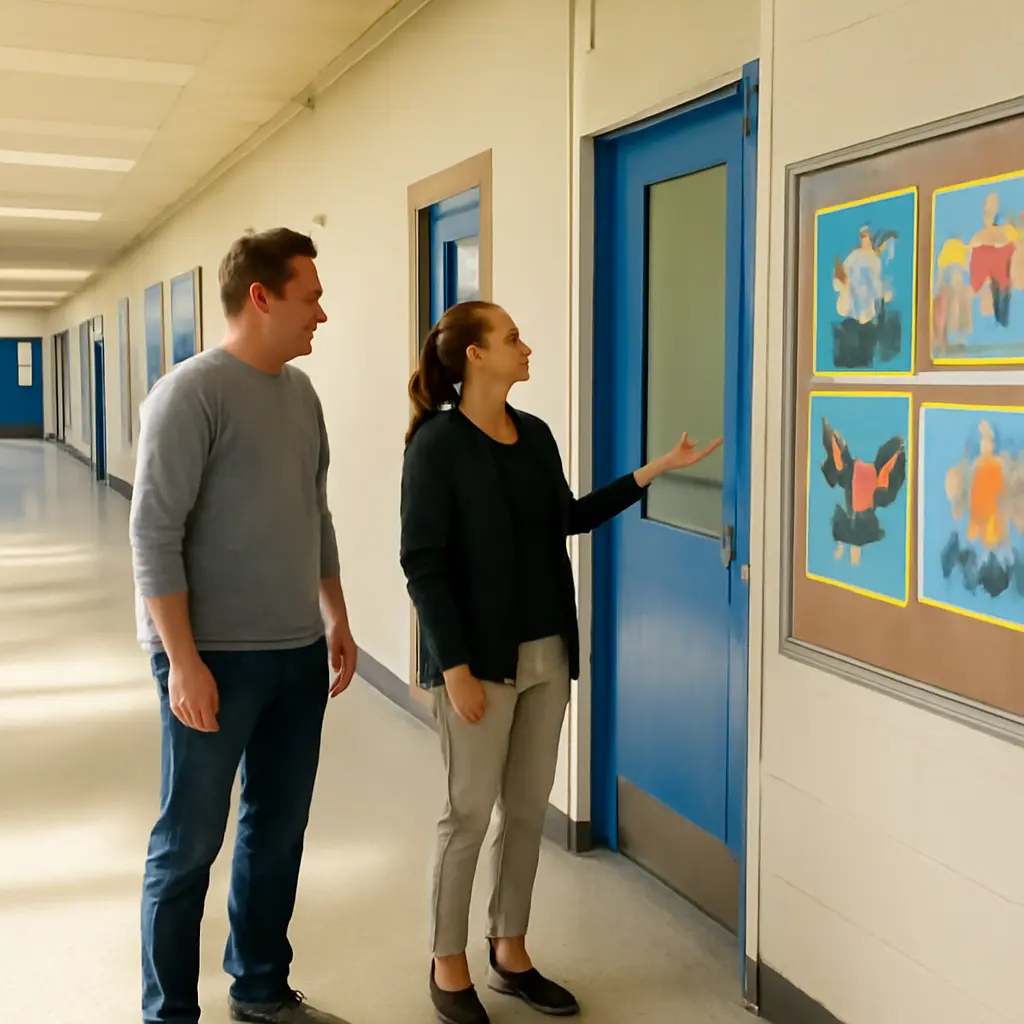
Comparing what schools say versus what parents discover on tours
A school’s description of its programs is a promise; a campus tour is a chance to test that promise against everyday evidence. Comparing school claims with what parents observe means checking whether statements about teaching, safety, class size, student support, and school culture match what is visible and verifiable. This matters because school-choice decisions affect children’s learning and well-being, while public data can describe broad patterns but cannot show every classroom in action. The most useful approach combines school documents and reported figures with careful observation, specific questions, and follow-up checks.
How school claims compare with parent tour evidence
There is no single research definition for “school claims versus tour evidence.” In this article, the comparison means evaluating a school’s stated features against information parents can observe or independently verify. A tour is a limited sample, not a complete audit: it may take place at a carefully selected time, and visitors may see only a small part of the school. Treating claims as questions to investigate—rather than facts to accept or reject immediately—helps parents make a fairer comparison.
The evidence should be triangulated: compare what staff say with written policies, publicly available data, and observations from more than one setting or interaction. The National Center for Education Statistics’ Common Core of Data provides information on public schools and districts, while the U.S. Department of Education’s Civil Rights Data Collection tracks selected education and discipline indicators. These sources offer useful context, but neither can establish what a particular child will experience in a specific classroom.
Program claims and classroom practice
A program claim describes what a school says it provides, such as project-based learning, small-group instruction, language immersion, or enrichment. Parents can test the claim by asking what students actually do, how often they do it, and how the school checks learning. For example, “individualized instruction” is more informative when staff can explain how teachers use assessment results, adjust lessons, and communicate progress than when it appears only in promotional language.
During a tour, look for evidence consistent with the explanation: student work, lesson materials, active participation, and clear routines. A quiet classroom alone does not prove strong teaching, just as a lively classroom does not prove weak management. Ask whether the observed lesson is typical and whether visitors may speak with teachers or see additional classrooms. The National Assessment of Educational Progress can provide national and state-level achievement context, but it does not rate an individual school’s daily teaching or explain why outcomes differ.
Class size, staffing, and student support
Claims about small classes or strong student support need operational definitions. Ask whether a quoted class size is an average, a maximum, or a figure for a particular grade; whether aides are included; and how staffing changes across subjects. The National Center for Education Statistics reports pupil–teacher ratios for public schools, but a schoolwide ratio is not the same as the number of students a child encounters in each class.
For counseling, special education, English learner services, or academic intervention, ask who provides the service, how students qualify, how frequently support occurs, and how families are informed. Parents can also review applicable public reporting and ask how the school responds when demand exceeds available staff. A tour may reveal whether support spaces exist, but it cannot establish service quality or eligibility; those details should be confirmed in writing and, where relevant, in the child’s individualized education or support plan.
What parents can verify on a school tour
A tour is most useful when parents distinguish direct observations from interpretations. “The hallway was noisy at 10 a.m.” is an observation; “students are always unsupervised” is a broader conclusion that requires more evidence. This distinction helps prevent one unusual moment from outweighing policies, records, and repeated observations.
Safety, supervision, and school climate
Safety claims may concern visitor access, arrival and dismissal, emergency procedures, bullying response, or adult supervision. Parents can ask how visitors are checked in, who supervises transitions, how incidents are reported, and how families receive follow-up. Observe whether staff can explain procedures consistently, while recognizing that some security details should not be publicly disclosed.
School climate is broader than the absence of visible conflict. The U.S. Department of Education’s Civil Rights Data Collection provides national data on topics such as school discipline and access to certain educational opportunities, while state and district report cards may provide local measures. These datasets can flag questions, but they do not capture every student’s experience. Ask how the school gathers student and family feedback and what it changes in response.
Facilities, routines, and accessibility
Facilities claims cover the condition and usability of classrooms, libraries, playgrounds, bathrooms, and shared spaces. A tour can reveal visible maintenance issues, accessibility barriers, signage, and how students move between activities. Parents should ask whether a displayed facility or resource is regularly available to the child’s grade, rather than assuming that every space shown is part of the daily program.
A single visit cannot establish how a building functions throughout the day or across seasons. Families may ask about cleaning and maintenance schedules, accessibility accommodations, lunch and recess routines, and any planned construction. If a school advertises specialized equipment or technology, ask which students use it, how often, and what training staff receive.
Family communication and school culture
Communication claims describe how the school shares academic progress, behavior concerns, announcements, and opportunities for family participation. Ask which channels are used, how often teachers communicate, what language-access services are available, and who responds when a family raises a concern. A welcoming tour is useful evidence of the visit itself, but it does not by itself show how communication works during a difficult situation.
To assess culture more reliably, compare the school’s stated values with concrete examples: how staff describe resolving disagreements, how students’ identities and needs are supported, and how families can raise concerns without being redirected indefinitely. Where possible, speak with more than one staff member and consult current families through appropriate, school-approved channels. Look for consistency rather than relying on a single polished explanation.
How to test school statements fairly and systematically
A structured comparison reduces the risk of being swayed by attractive displays, confident language, or one memorable observation. It also helps families compare schools using the same criteria rather than changing standards from visit to visit.
Use a claim–evidence–question checklist
Before the tour, list the school’s most important claims and define what evidence would support each one. For a promise of “strong family partnership,” for instance, evidence might include a clear contact process, interpretation options, regular progress updates, and examples of family input leading to action. Record what was directly observed, what staff reported, and what remains unverified.
- Write down the exact claim and where it appeared: website, handbook, meeting, or tour.
- Ask for a specific example, frequency, responsible staff member, and written policy where applicable.
- Separate direct observations from assumptions and note the date, time, and setting.
- Check public data and school documents, then ask about differences between the records and the school’s explanation.
- Follow up in writing on consequential questions, especially services, eligibility, costs, and accommodations.
This method is consistent with the broader principle of evaluating evidence by its source and scope. For example, an overall attendance or achievement figure can describe a population, but it should not be treated as a guarantee for an individual student. Likewise, a tour observation can identify a question without proving that a practice is typical.
Compare like with like and account for selection effects
Fair comparisons require consistent questions across schools. Ask each school how it defines class size, measures progress, handles behavior, and provides support. Check whether statistics refer to the same school year, grade range, student group, and measurement method. A percentage without a denominator or date can be difficult to interpret.
Tours also involve selection effects: the school chooses the schedule, route, and staff available, while parents may see only a brief snapshot. Where possible, request a visit during ordinary school hours, ask whether a classroom observation is permitted, and arrange a second conversation with the person responsible for the program of greatest importance to your child. Do not infer that a staged presentation is deceptive; instead, seek corroboration before making a decision.
Conclusion: Turn school promises into verifiable questions
Comparing school claims with parent tour evidence means testing statements about instruction, staffing, safety, facilities, and communication against observable practice and reliable records. Public datasets from the National Center for Education Statistics and the U.S. Department of Education add context, while a tour helps families ask how those broad measures translate into daily routines. Neither source is sufficient alone.
Parents can make a more informed choice by recording claims, asking precise follow-up questions, comparing schools on the same criteria, and confirming important details in writing. For further research, consult state and district report cards, school handbooks, relevant federal education data, and the policies that apply to your child’s needs. The goal is not to catch a school out; it is to understand what it can reliably provide and whether that matches the child and family.
Sources: National Center for Education Statistics, Common Core of Data (CCD), https://nces.ed.gov/ccd/; National Center for Education Statistics, National Assessment of Educational Progress (NAEP), https://nces.ed.gov/nationsreportcard/; U.S. Department of Education, Civil Rights Data Collection (CRDC), https://civilrightsdata.ed.gov/