
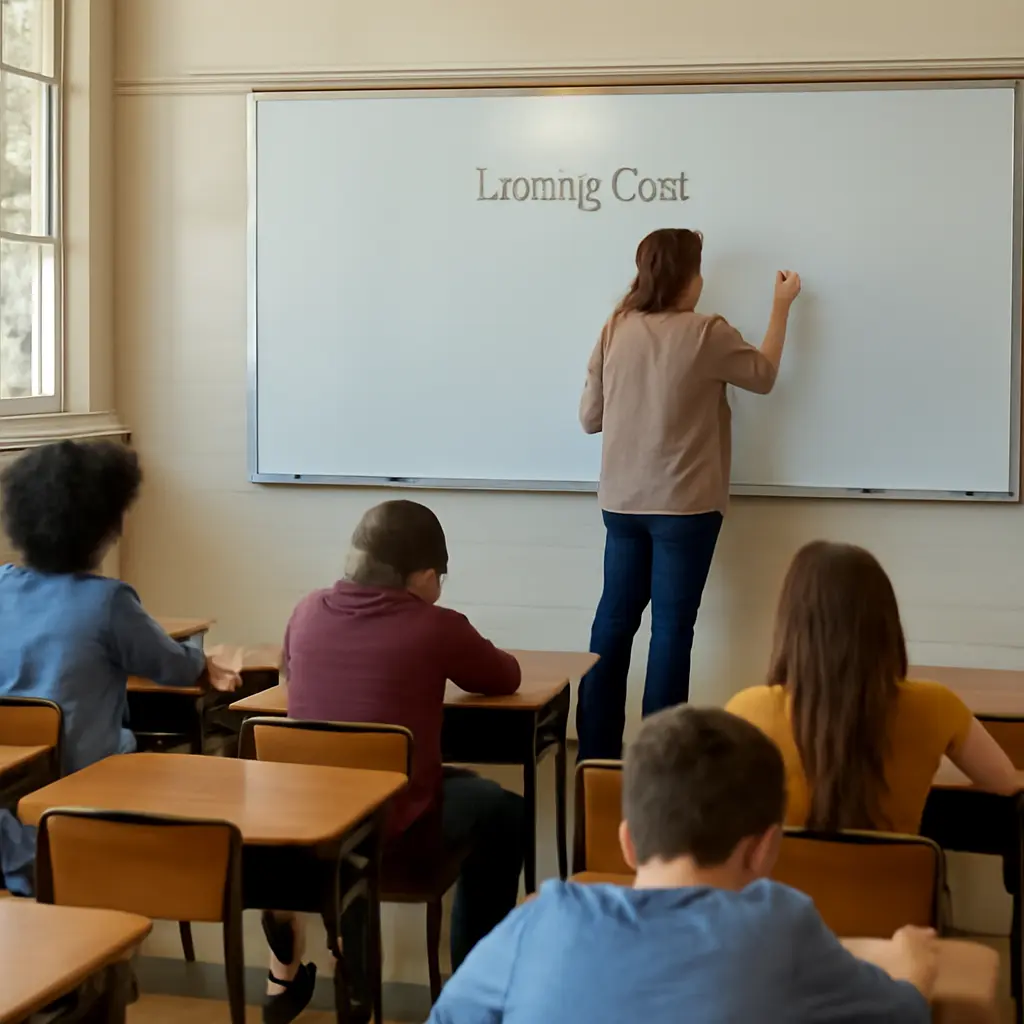
The confidence gap nobody talks about in traditional education
Traditional education can measure what students know more easily than whether they believe they can learn. That difference is the confidence gap: the distance between demonstrated ability and a learner’s belief that they can succeed. It matters because confidence shapes participation, persistence, and willingness to tackle difficult work, yet it is not the same as competence or a simple measure of self-esteem. Research on academic self-efficacy, belonging, feedback, and student engagement helps explain how the gap develops—and how schools can narrow it through meaningful practice, supportive relationships, and evidence-based feedback.
Academic confidence: what the confidence gap means in traditional education
The confidence gap in education is a mismatch between a student’s actual or developing capability and their belief that they can perform a specific learning task. Psychologist Albert Bandura defined self-efficacy as people’s beliefs about their capabilities to organize and carry out actions needed to achieve particular goals. In school, academic self-efficacy is therefore task-specific: a student may feel confident in science but doubt their ability to write an essay or speak in class.
This distinction matters. Confidence is not a substitute for knowledge, and high confidence does not guarantee strong performance. But students who expect that effort and effective strategies can help them succeed are more likely to attempt challenging work, persist after setbacks, and seek help. The OECD’s PISA 2022 results show that mathematics performance and students’ reported confidence-related attitudes are associated, while also documenting substantial differences in achievement and well-being across students and systems. Such associations do not prove that confidence alone causes achievement; they underline why schools should consider both learning outcomes and students’ experience of learning.
Academic self-efficacy: confidence tied to a particular task
Academic self-efficacy is a learner’s judgment of their ability to complete a defined academic task, such as solving a set of equations or revising a paragraph. Bandura identified mastery experiences—successfully completing challenging tasks—as an especially influential source of efficacy beliefs. When students get scaffolded opportunities to improve and can see what they did to make progress, confidence can become grounded in evidence rather than empty reassurance.
A student who says, “I can’t do math,” may be describing repeated difficulty, fear of being wrong, or a narrow experience of success—not a fixed limit. Breaking a complex task into achievable steps, giving students a chance to practise, and showing how strategies transfer can help them build a more accurate sense of what they can do. Confidence should be checked against work and progress, not inferred from a student’s volume, speed, or willingness to volunteer.
Self-concept and belonging: the wider story students tell themselves
Academic self-concept refers to a student’s broader perception of their ability in a subject or school context, while belonging concerns whether they feel accepted and valued in that setting. These ideas connect to, but are not interchangeable with, self-efficacy. A learner might believe they can complete an assignment yet feel that their ideas are unwelcome in class; another may feel included but doubt their subject skills.
The National Student Engagement and Belonging survey research and the OECD’s PISA reporting both draw attention to students’ experiences of relationships, safety, and engagement alongside academic outcomes. These measures are influenced by context and should not be treated as universal diagnoses. Still, they point to a practical concern: confidence is harder to sustain when students expect ridicule, bias, or exclusion. Fair participation routines and respectful classroom norms can make it safer to ask questions and learn publicly.
Traditional assessment can reveal achievement while hiding confidence
Traditional education often relies on grades, timed tests, and visible classroom participation. These measures can provide useful evidence of learning, but they do not fully reveal how students understand their own capacity. A test score records performance under particular conditions; it does not explain whether a student felt prepared, guessed successfully, froze under pressure, or knows how to improve next time.
The confidence gap can appear in several forms: capable students who underestimate themselves, students who appear confident but have unrecognized learning gaps, and learners whose confidence varies across subjects or social settings. Treating these patterns as one problem risks missing their causes. A contextual bridge is needed between assessment and instruction: educators can pair performance evidence with observation, student reflection, and feedback about specific strategies.
Grades, tests, and the limits of performance signals
A grade compresses many kinds of information into a single symbol. It may reflect knowledge, task completion, test conditions, or a teacher’s assessment criteria, but it rarely tells a student precisely which strategy worked or what to practise. When grades become the main measure of ability, a low result can be interpreted as a verdict on identity instead of information about a particular attempt.
The Education Endowment Foundation’s guidance on feedback emphasizes that feedback is most useful when it helps learners understand their current performance and the next steps toward a learning goal. That principle applies whether feedback accompanies a test, project, or classroom discussion. A score can be retained, but it should be paired with actionable information—such as identifying a misconception, modelling a revision, or giving students a chance to apply advice.
Participation and visibility: why quiet students may be overlooked
Classroom participation is not a reliable stand-alone measure of confidence or understanding. A student may know the material but hesitate to speak because of language demands, anxiety, cultural expectations, or fear of public error. Another may answer quickly without having developed a secure understanding. If teachers equate speaking up with confidence, they can mistake visibility for capability.
Offering multiple ways to contribute—think time, paired discussion, written responses, anonymous questions, or small-group explanation—gives students more than one route into learning. These options do not lower expectations; they make the evidence of thinking more accessible. Teachers can then distinguish a knowledge gap from a participation barrier and respond appropriately.
Feedback and classroom practice can build evidence-based confidence
Confidence becomes more durable when students can connect effort, strategy, feedback, and improvement. The aim is not to praise every outcome or promise that anyone can master anything instantly. It is to help learners identify what they can control, recognize progress, and develop strategies for the next challenge. This approach links academic self-efficacy to formative assessment and a classroom culture where mistakes can be examined without humiliation.
Specific feedback: praise the process, clarify the next step
Useful feedback describes the work rather than assigning a broad label to the student. “Your evidence supports the claim; now explain how the quotation connects to it” gives a clearer path forward than “You’re brilliant” or “Try harder.” Process-focused feedback helps learners see how particular choices contributed to an outcome and what adjustment might improve their next attempt.
The Education Endowment Foundation’s synthesis of evidence on feedback stresses that its impact depends on how it is designed and used. Feedback that is vague, overwhelming, or focused only on the person may not help learning. A practical cycle is to state the learning goal, identify one or two useful next steps, and provide time for the student to act on them. That final opportunity matters: feedback without a chance to revise can leave students with information but no experience of improvement.
Scaffolding and productive challenge
Scaffolding provides temporary support—such as worked examples, prompts, models, or guided practice—so students can attempt work they could not yet manage independently. Productive challenge keeps the learning goal ambitious while adjusting the route toward it. When support is gradually withdrawn, students can recognize that they are taking on more responsibility and building competence.
The National Academies’ work on how people learn emphasizes the importance of building on prior knowledge and making learning processes visible. In practice, a teacher might model a problem-solving strategy, guide a class through a similar example, and then ask students to solve a new problem independently. If learners struggle, the response is not automatically to remove the challenge; it may be to identify the missing prerequisite or provide a better scaffold.
Growth mindset: useful when paired with real support
A growth mindset is the belief that abilities can develop through learning, practice, and effective strategies. It is related to confidence but does not mean that effort alone guarantees success. Students also need instruction, time, access to resources, and feedback that helps them choose productive strategies. Telling a learner simply to “work harder” can obscure barriers or reinforce frustration when effort is not matched by useful support.
The Education Endowment Foundation’s review of growth mindset interventions cautions that effects are not automatic and that implementation matters. A balanced classroom message acknowledges both development and conditions: skills can improve, mistakes can inform the next attempt, and teachers are responsible for making high-quality learning opportunities available. This keeps encouragement connected to instruction rather than turning it into a slogan.
Equity and measurement: identify whose confidence is being missed
The confidence gap is also an equity issue because students’ opportunities to demonstrate ability and receive recognition are not always distributed evenly. Expectations, representation in the curriculum, classroom relationships, disability accommodations, language access, and prior educational opportunity can shape how students interpret success and failure. Confidence should therefore be understood in context, not used to label individuals or explain away structural barriers.
Stereotypes, identity, and classroom expectations
Stereotype threat describes the risk that awareness of a negative stereotype about one’s group can add pressure in a situation where performance is being judged. Research on this topic has examined how social context may affect performance, though the size and consistency of effects vary across settings and studies. The educational implication is not to assume that every student from a particular group lacks confidence; it is to examine whether classroom routines, examples, and expectations create unnecessary threat or unequal access to recognition.
Teachers can reduce avoidable barriers by using transparent assessment criteria, representing varied contributors in course materials, distributing opportunities to lead, and responding consistently to student ideas. They can also compare their assumptions with evidence: who is asked to explain, whose errors receive constructive attention, and who gets invited into advanced work? Such questions shift the focus from presumed student deficits to the learning environment.
Measure confidence alongside learning—not instead of it
A school can explore the confidence gap through brief, low-stakes student reflections, task-specific confidence ratings, work samples, and conversations about learning strategies. These indicators should be compared with academic evidence over time. A mismatch—such as strong work paired with persistent self-doubt—may invite supportive discussion, while high confidence paired with recurring errors may signal a need for clearer feedback or closer assessment of understanding.
Self-reports are not objective measurements of ability: responses may change with mood, language, interpretation, and classroom trust. They should not be used to rank students or make high-stakes decisions. Instead, they can help educators ask better questions and evaluate whether changes in instruction are improving both learning and students’ sense of agency.
A practical school approach to closing the confidence gap
Closing the gap does not mean making students feel capable regardless of evidence. It means creating conditions in which capability can grow and students can recognize that growth. Schools can use a simple cycle: establish a clear learning goal, provide supported practice, gather evidence, give actionable feedback, and invite students to reflect on what changed.
- Set transparent goals and explain what successful work looks like.
- Offer appropriately challenging tasks with models and scaffolds that can be reduced over time.
- Use specific feedback that identifies strengths, misconceptions, and a manageable next step.
- Provide revision and retry opportunities so students can turn feedback into visible progress.
- Gather student perspectives through reflection and discussion, then check those perspectives against work and assessment evidence.
For example, a student who avoids presenting may first explain an idea to a partner, then record a short presentation, and later speak to a small group. The teacher can assess the quality of the explanation while helping the student build experience in increasingly public settings. This is not a guarantee that anxiety disappears; it is a structured way to practise, receive feedback, and expand participation without treating reluctance as lack of ability.
Conclusion: confidence is part of learning, not a replacement for it
The confidence gap in traditional education describes a mismatch between what students can do and what they believe they can do. Academic self-efficacy, self-concept, and belonging help explain different parts of that experience, while grades and participation alone can miss important signals. Specific feedback, scaffolded challenge, inclusive classroom practice, and careful measurement can help students build confidence grounded in real progress.
Educators and school leaders can begin by asking students where they feel capable, where they hesitate, and what evidence or support would help them take the next step. Then they can pair those answers with classroom work and adjust instruction accordingly. For further reading, consult Bandura’s work on self-efficacy, the OECD’s PISA findings, and evidence reviews from the Education Endowment Foundation. The broader goal is not confidence for its own sake, but an education system in which every learner has a fair chance to develop skill—and to recognize that development.
Sources: Albert Bandura, “Self-Efficacy: Toward a Unifying Theory of Behavioral Change,” Psychological Review, 1977, https://doi.org/10.1037/0033-295X.84.2.191; OECD, PISA 2022 Results, Volume I: The State of Learning and Equity in Education, 2023, https://doi.org/10.1787/53f23881-en; Education Endowment Foundation, Teacher Feedback to Improve Pupil Learning, 2021, https://educationendowmentfoundation.org.uk/education-evidence/guidance-reports/feedback; National Academies of Sciences, Engineering, and Medicine, How People Learn II: Learners, Contexts, and Cultures, 2018, https://doi.org/10.17226/24783; Education Endowment Foundation, Changing Mindsets: A Review of the Evidence, 2019, https://educationendowmentfoundation.org.uk/education-evidence/evidence-reviews/teaching-learning-toolkit/growth-mindset